APA vs MLA: quick answer
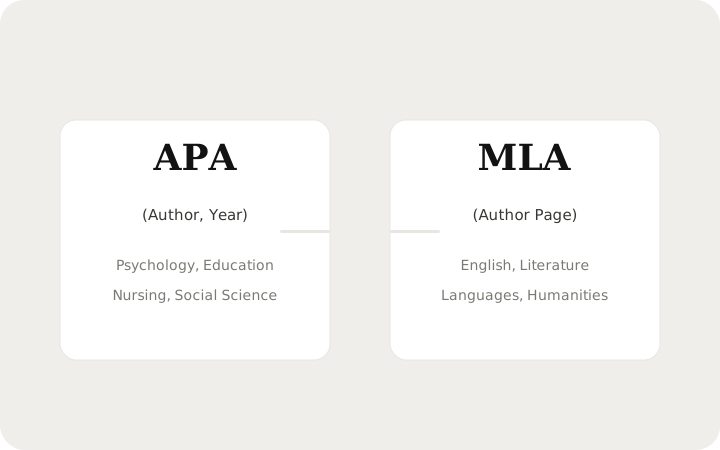
APA 7 is the standard in psychology, education, nursing, business, and the social sciences. MLA 9 is the standard in English, literature, foreign languages, and the humanities. The core difference: APA in-text uses (Author, Year) — research is date-sensitive. MLA in-text uses (Author Page) — the specific passage matters. This one difference in in-text format cascades into how you format every reference entry, from author names to title capitalization to where the date appears.
If your syllabus says APA, use the APA Citation Generator. If it says MLA, use the MLA Citation Generator. If you are unsure, check the table below — the disciplines are the most reliable indicator.
Where each style is used — and why it matters
APA emerged from psychology in 1929. The American Psychological Association needed a format that emphasized the recency of research because a 2023 study on cognitive bias might supersede a 2008 study on the same topic. The date goes immediately after the author name in both the in-text citation and the reference entry because when the research was published changes how it should be weighed [1].
MLA emerged from literature and language studies. The Modern Language Association needed a format that emphasized where in a text an idea appeared because a line from page 42 of a novel has a different meaning than a line from page 3. The page number is the central identifier, not the year [2].
| APA 7 | MLA 9 |
|---|---|
| Psychology | English & literature |
| Education & special education | Foreign languages & comparative literature |
| Nursing, medicine, public health | Cultural studies & ethnic studies |
| Business, management, economics | Philosophy & religious studies |
| Sociology, anthropology, social work | Art history, musicology, theater |
| Criminology & criminal justice | Film & media studies |
| Political science & public policy | Rhetoric & composition |
| Communication & journalism | Creative writing |
In-text citations: what actually changes
The in-text citation format is where students make the most errors when switching between styles. Here is the same source cited in both formats, followed by the rules.
APA 7 in-text rules
- Narrative citation: “Smith (2023) found that...” — author name in the sentence, year in parentheses.
- Parenthetical citation: “The results confirmed the hypothesis (Smith, 2023).” — both in parentheses, separated by comma.
- Direct quote with page: “The data were conclusive (Smith, 2023, p. 42).” — p. for a single page, pp. for a range.
- Two authors: (Smith & Jones, 2023) — use & inside parentheses, “and” in narrative.
- Three or more authors: (Smith et al., 2023) — APA 7 uses “et al.” for 3+ from the first citation. APA 6 required listing up to 5 in the first citation — a major 7th edition change.
MLA 9 in-text rules
- Parenthetical citation: “The results were conclusive (Smith 42).” — no comma between author and page. No “p.” or “pp.”
- Signal phrase: “Smith argues that the results were conclusive (42).” — page alone at the end when the author is named in the sentence.
- Two authors: (Smith and Jones 42) — write out “and,” not &.
- Three or more authors: (Smith et al. 42) — same pattern as APA but without the comma before the page.
- No page available: (Smith) — omit the page. Do not invent one. For online sources, MLA recommends the author alone.
- Corporate author: (National Institutes of Health 12) — write out the full organization name. Common mistake: abbreviating it in-text.
The most common mistake students make: using (Smith, 2023, p. 42) in an MLA paper. The year, comma, and “p.” all belong to APA. In MLA, the same source would be (Smith 42). Your instructor notices this immediately.
Reference list: side-by-side comparison
The same journal article formatted in APA 7 and MLA 9, with every difference annotated:
APA 7:Shokri, A., & Que, L. (2015). Conversion of aldehyde to alkane by a peroxoiron(III) complex: A functional model for the cyanobacterial aldehyde-deformylating oxygenase. Journal of the American Chemical Society,137(24), 7686–7691. https://doi.org/10.1021/jacs.5b01053
MLA 9:Shokri, Alireza, and Lawrence Que. “Conversion of Aldehyde to Alkane by a Peroxoiron(III) Complex: A Functional Model for the Cyanobacterial Aldehyde-Deformylating Oxygenase.” Journal of the American Chemical Society, vol. 137, no. 24, 2015, pp. 7686–91. doi:10.1021/jacs.5b01053.
| Element | APA 7 | MLA 9 |
|---|---|---|
| List title | References | Works Cited |
| Author names | Last, F. M. (initials only) | Last, First M. (full first name) |
| Date placement | Right after author: (2015). | After journal name, volume, and issue: 2015, |
| Article title case | Sentence case: only first word and proper nouns capitalized | Title case: all major words capitalized |
| Article title formatting | Plain text | In quotation marks |
| Journal title | Italicized, Title Case | Italicized, Title Case |
| Volume/issue | 137(24) — volume italicized, issue in parentheses, no “vol.” | vol. 137, no. 24 — “vol.” and “no.” spelled out |
| Pages | 7686–7691 (full page range) | pp. 7686–91 (abbreviated second number) |
| DOI format | https://doi.org/10.1021/... | doi:10.1021/... |
| Hanging indent | 0.5 inches | 0.5 inches |
Six common mistakes when switching between APA and MLA
- Copying the in-text format across styles.(Smith, 2023, p. 42) is APA. (Smith 42) is MLA. If you paste an APA in-text citation into an MLA paper, the year, comma, and “p.” are all wrong. Rewrite from scratch — do not edit in place.
- Using initials in MLA.APA abbreviates first names: “Shokri, A.” MLA requires the full first name: “Shokri, Alireza.” If your generator output shows initials in an MLA paper, the style setting is wrong.
- Forgetting title case in MLA. APA uses sentence case for article titles (only first word capitalized). MLA uses headline-style title case (all major words capitalized). Switching between them requires manual review — a generator may not catch every word.
- Omitting the container in MLA.MLA 9 requires the “container” — the larger work that holds the source. For an article, the journal is Container 1. For a chapter, the book is the container. APA does not use the container concept. Students who treat MLA like APA often leave out the container entirely.
- Treating “n.d.” as universal.APA 7 uses (n.d.) when no date is found. MLA 9 does not use “n.d.” — it omits the date entirely. If you see “n.d.” in an MLA citation, the generator applied the wrong style.
- Mislabeling the reference list.APA calls it “References.” MLA calls it “Works Cited.” They are not interchangeable. Instructors check the heading before they check individual citations.